A quiet tool for awareness, stability and creative freedom
Most of us like to think we are acting freely.
We choose our careers, our opinions, our priorities. We decide what matters, what to ignore, what to push back on. And yet, when we pause long enough to observe ourselves honestly, a more complex picture often emerges.
Much of what we do — and much of what we believe — is shaped long before we consciously choose it.
This is not a criticism. It is simply a fact of being human, a fact that in our formative years as children we are set to question, listen and absorb to build the world as we will come to know it in our minds or put another way developing the generative models that underpin our minds Markov blanket. Through this process in early childhood onward, we are influenced by people and systems that seek to guide us: parents, teachers, faith leaders, institutions, cultures and communities. Historically, these influences were relatively visible and bounded. You were usually aware who was shaping your worldview and roughly why, certainly when you look back at it.
Today, the situation is different.
Influence has become more diffuse, more constant and often less transparent. Ideas reach us through countless channels from far and wide, many of them algorithmically curated, emotionally charged and optimised for attention rather than understanding. The result is not necessarily manipulation, but it is pressure. Pressure on our attention. Pressure on identity. Pressure on coherence.
This is where I believe the Principle of Purpose can serve us ordinary people in a very practical way.
Not as a belief system.
Not as a defence mechanism.
And certainly not as a tool for judging others.
But as a means of orientation.
Purpose as a stabilising reference point
At its simplest, the Principle of Purpose invites a single question:
What is the purpose behind this action, message or direction — and how strongly is it pulling?
That question can be applied inwardly or outwardly.
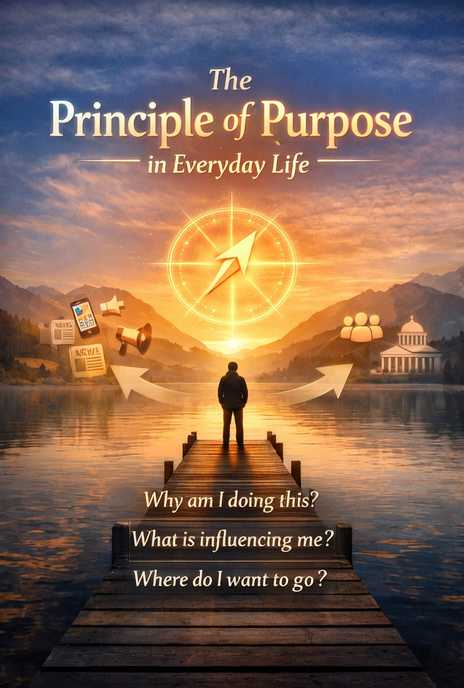
- Why am I doing this?
- What is this person or system trying to achieve?
- What outcome does this behaviour appear to serve?
- Is the purpose explicit, implied or hidden?
- How aligned is this purpose with my own values, goals and energy?
I believe when purpose is clear and coherent, behaviour tends to feel grounded, even if we disagree with it. When purpose is fragmented or obscured, behaviour often feels unsettling, urgent or emotionally charged without quite making sense.
Recognising this distinction can be surprisingly calming.
Instead of reacting to content alone, can I suggest we begin to perceive direction.
Understanding influence without demonising it
I think one of the traps of modern discourse is the tendency to frame influence as inherently sinister. I do not see it that way.
Influence is unavoidable. Every society depends on it.
Parents influence children because they must. Religious leaders influence followers because shared belief systems require continuity. Political leaders influence populations because coordination at scale demands narrative and direction.
Even poorly informed guidance is often rooted in care, fear or inherited assumptions rather than malice.
The issue is not that influence exists.
The issue is whether we understand how it works and how it interacts with our own inner purpose.
When we lack that understanding, or fail to pause and think on it, influence can feel overwhelming or invasive. When we gain it, influence becomes something we can observe, evaluate and even play with intellectually.
I think that shift alone can stabilise mental health.
From reaction to navigation
Many people today feel mentally fatigued not because life is harder than before, but because their minds are constantly being pulled in multiple directions at once.
The Principle of Purpose offers a way to move from reaction to navigation.
Instead of asking:
- Is this right or wrong?
- Do I agree or disagree?
- Should I feel outraged or reassured?
We can ask:
- What is the directional intent here?
- What energy is this trying to mobilise in me?
- Does engaging with this strengthen or fragment my own coherence?
I feel this reframing does something subtle but powerful:
It returns agency to us as an individual.
You no longer need to fight ideas, suppress them or blindly accept them. You can simply locate them within a landscape of purposes — including your own, in your own mind’s world.
Enjoying the challenge rather than fearing it
Something unexpected often happens when we adopt this stance.
We stop feeling threatened by challenging ideas.
Instead, we become curious.
Mentally provocative content becomes an opportunity to test alignment, sharpen thinking and explore alternatives without destabilisation. The mind becomes less brittle, more playful, more creative.
This is not detachment. It is engagement with boundaries.
You can listen deeply without absorbing uncritically.
You can explore narratives without living inside them.
You can disagree without hostility and agree without surrender.
In that sense, the Principle of Purpose does not narrow thinking, it expands it.
A personal note on the Principle of Purpose
I do not see this framework as the answer — only one lens among many that has helped me remain grounded in a complex, noisy world.
I am not seeking to influence others, convert beliefs or critique institutions. My interest is simpler than that.
I believe that when people understand the mechanisms shaping their attention, motivations and choices, they become more stable, more resilient and more creatively alive.
And perhaps — quietly — freer.
Read the full paper
The full paper is available CLICK HERE
It includes the deeper structure; Diagrams and a more detailed exploration of how the framework applies in the real world today.
I hope you find it useful and thought provoking.