Over the past week I read a powerful piece about AI acceleration written by Matt Shumer.
It was urgent. Honest. Uncomfortable.
And I agreed with much of it.
This is not incremental progress anymore. The pace is real. The capability jump is real.
Many professionals like us are already experiencing something unprecedented:
Tasks that once required expertise, iteration and time are now executed by AI systems in hours — sometimes minutes.
That is not hype.
But I find myself framing the moment slightly differently.
This Is Not Just an Intelligence Explosion
AI is dramatically increasing the total cognitive and productive capacity available to us.
One person can now:
- Prototype in an afternoon
- Analyse in minutes
- Generate in scale
- Iterate without friction
The barrier between idea and execution is collapsing.
But here is the question that concerns me more than job displacement:
Are we prepared to clarify our direction as our capacity expands?
Because I think history shows us something important:
When energy increases faster than orientation, instability follows.
Superiority Maybe the Wrong Frame ?
Nature is full of intelligences superior to us in specific domains.
A cheetah outruns us. A fern optimises energy conversion better than we ever could. A wood louse survives in environments we cannot tolerate.
Yet coexistence is not structured around superiority.
It is structured around alignment.
AI will out-reason us in many cognitive tasks.
Yet perhaps this is not the central issue.
The central issue is whether we humans remain clear about what we are aiming toward.
AI optimises. Humans orient.
If we do not define direction clearly, optimisation simply runs faster.
The Real Call to Action
Yes — learn the tools. Yes — experiment daily. Yes — integrate AI into your work.
But alongside that:
Strengthen your coherence. Clarify your Purpose. Practice conscious direction.
Because as our total cognitive and productive capacity increases, the leverage point moves upstream.
Then the critical question becomes:
What goals are we setting? What values are we encoding? What problems are we choosing to solve?
Then perhaps this moment is less about “AI replacing humans” and more like a maturation test for humanity.
Then Being Human Becomes a Discipline
As digital intelligence expands, uniquely human capacities become more visible — not less.
- Embodied judgment
- Sensory awareness
- Moral responsibility
- Emotional depth
- Meaning creation
AI can generate. AI can optimise. AI can iterate.
But it does not inhabit consequence.
We do.
Which means the responsibility for direction still rests with us.
The Bigger Picture
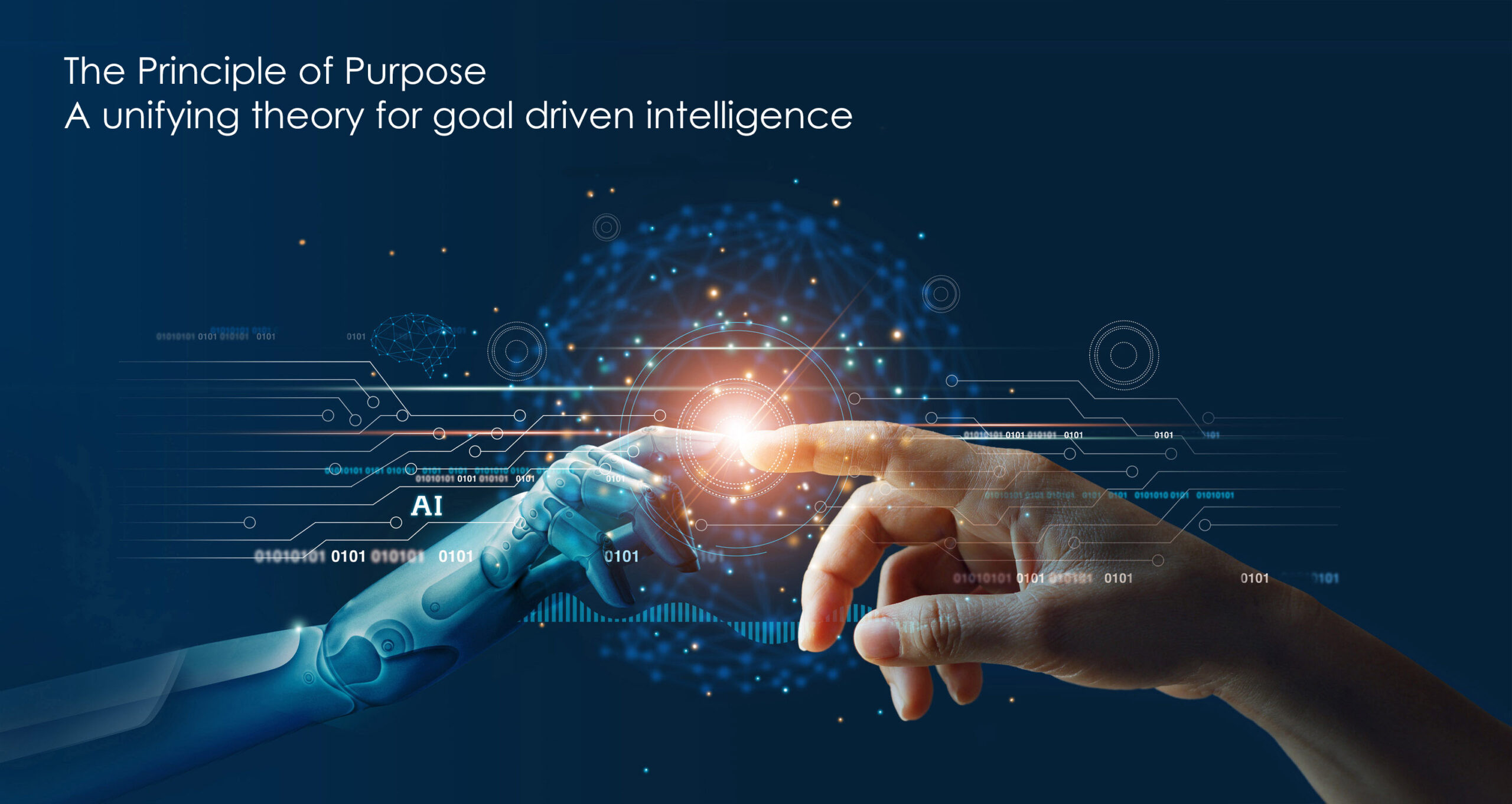
I have been exploring these ideas in my own work around how systems sustain direction under increasing capacity — something I call The Principle of Purpose.
Regardless of framework, the pattern seems clear:
When capability accelerates, clarity becomes essential.
The future will not be shaped only by the speed of the models.
It will be shaped by the quality of our orientation.
We are not at the end of human relevance.
We are at the end of human complacency.
And perhaps the real opportunity is not simply to survive AI or avoid being enslaved by it, but to elevate how we define progress itself and where we want to fit into it.